Sunday, 17 July 2016

Monday, 30 May 2016
Sunday, 24 April 2016
The Self Possessed
Winter sleeps and dreams of Summer
As does Autumn, as does Spring
but Summer, in its fleeting fullness
dreams it is beyond such things.
Friday, 1 January 2016
Sunday, 6 December 2015
Saturday, 24 October 2015
Sunday, 4 October 2015
Sunday, 16 August 2015
Sunday, 9 August 2015
Kyoru lyrics (rejected)
High grade,
Retro ticker-tape display
tribute to how they rolled
back in the glory days
Short trade,
rehypothecate
spinning all the strands
out into endless space
Suit, shades
you’re all about the money game
now no-one wants to stage
your world-changing play
chorus:
their sad eyes look up to me
all across this once great nation
what did you do daddy
during the great moderation?
oh, bring it back again,
my cheap faith.
Dark days
you shouldn’t have to die this way
after a lifetime cultivating
such expensive tastes.
Throw shade,
take a bullet for the old Beltway
dose up on the meds they gave you
turn sharp right at centre stage
Chorus:
all the lost souls cry out to me
from these ruined conurbations
what did you do for me
during the great moderation?
there’s no price I wouldn’t pay
to have it back again
kneel my children, pray
for some cheap faith.
Sunday, 2 August 2015

Barricades (diversion)
Lyrics (accepted)
God knows the dream
the green and golden leaves
from sea to shining sea
in perfect sympathy
the dogs in the street
the pavement-cracking weeds
the spores and drifting seeds
all searching for release
the silent spring
all summer long
we know to whom
the world belongs
the pile of grain
the hopeful face
meet me at
the barricades.
Saturday, 1 August 2015
Utopia Then! (3) Cosmos
Social Democracy has failed because of big government distorting the market, Communism will fail because after a certain developmental stage market liberalization must occur for a “mature” economy to thrive (and the later failure of the Soviet system will unleash a wave of told-you-say triumphalism.)
There’s much contemporary moaning about the loss of a cosmic vision on the left, that a reformulated Communism must have moon bases as a key element of its libidinal appeal, that with the end of actually existing Communism the space race is effectively decommissioned and Russian Cosmism consigned (along with Soviet Cybernetics) to the stockpile of fantasmatic futures, but in the 70s there is already a turn away from space exploration toward the development of IT and its commercialization. NASA funding progressively falls from a high of 4.41 percent of GDP in 1966 to 0.98 percent by 1975 to its current low of 0.49. In a sense the development of the P.C., the internet, the network and neoliberalism's vision of the market and the need for a new wave of profitable investments are deeply interrelated. From Cosmism, to Hayek’s Cosmos of the market, to the Internet as a Galaxy.

(Uncle Fred)
The Cosmic vision of neoliberalism might be called a virtualised Cosmism, the market as a sublime and a quasi-divine force, something ineffable woven into the fabric of the everyday. The Hayekian vision asks us to imagine ourselves as one twinking node in the vast, unmappable constellation of market decisions that increasingly encircles the earth, bringing a sense of religious awe to those who can glimpse something of the overall structure. Neoliberalism offers a re-enchantment of the world, your role as a consumer becomes primary, production is outsourced, the centres of capital focus on services and thereby commodities take on a magical property again, not just an agglomeration of dead labour time, but something that partakes of the absolute, re-sacralized. Several weeks ago, as an example, there was a libertarian MEP on Newsnight getting aggressively teary-eyed over a tin of beans, how seemingly mundane yet ultimately marvellous it was, this cheap comestible, the impossibly complex set of interactions and interrelations that produced it, the price mechanism, the global supply chains. Supermarkets become temples of wonder, credit is infinitely extended as prices fall, there are no factories or canneries to be seen for miles around. There is your Utopia, your magic kingdom, almost a land of Cockayne, the mythical land of plenty where fish jump out of the sea and land at your feet.
Neoliberalism has to offer itself as the harbinger of an earthly paradise, a real Utopia, an imminent Utopia, if we can only get rid of the government, if only we can purge those who are holding us back, who in preaching political democracy, prevent us from breaking through into a true democracy beyond party politics a truly democratized Capitalism in which, without any direct concern for my fellow citizen, without any distorting emotionalism or sense of social bonds I can be free at last to pursue my essentially selfish desires, with the bonus that, via the invisible hand, everyone will benefit. This an attempt to address the allure of communist forms of organization, essentially mass participation and radical democracy, the sublime deindividuation of collective utopian projects yet without losing a sense of Western individualism and reorient the drift away from materialism of the 60s.
That’s right, I am going to link that speech from Network. Again.
Like all systems, then, neoliberalism is caught up in its own fevered dream work, shifting between a disciplinarian “realist” and Utopian mode, and as it re-enchants it imposes new forms of hierarchy and discipline. There is the demand for a kind of absolute asceticism on the one hand, and for absolute indulgence on the other of the impulse to consume; greed is good. There is a kind a kind of anti-Prometheanism for the mass, man must submit himself to the market as before a Mao or Stalin, combined with a veneration of the entrepreneur as the world historical figure, creator of all value, the man who can sow and reap Schumpeter's gales of creative destruction.
In the Autumn of the system, when times are looking tough, we are told there is no other possibility, we must resist the sentimental notion that we can intervene in the market to create better outcomes. In this conception of the unfettered market as the ideal form of democracy there is an echo of Newspeak’s freedom is slavery and war is peace; helping only makes it worse, just as being selfless is to our own and other's detriment and planning means we will never achieve our objectives. There is a kind of infernal, gnostic stream within the neoliberal imaginary, a nightmare world in which all our humanist impulses will lead to their opposite effects, to a hell paved with good intentions, and in which to achieve our ends we must abrogate our deepest social and moral impulses, even perform their opposites. Thus we reach the situation in which it is necessary to act counter to one's morality in order to fulfill it, hence the split selves of neoliberalism, the torsion of psychic space in which nights of excess and days of rampant profiteering are the ways in which one fulfills one’s moral duty.
I don’t enjoy being a selfish, money-obsessed bastard you know, Nigel. I am doing it for everyone’s sake.
Saturday, 25 July 2015
Sunday, 19 July 2015
Pessoa
I feel love for all this, perhaps because I have nothing else to love ... even though nothing truly merits the love of any soul, if, out of sentiment, we must give it, I might as well lavish it on the smallness of an inkwell as on the grand indifference of the stars
Utopia Then (2) Zardoz.
One of the films that best captures the utopian anxieties of the Seventies' is Boorman’s addled farrago Zardoz, excellently summarized here on Wikipedia.
Zardoz isn’t alone of course in expressing pessimism about the rationalised, radically egalitarian Utopia that post war consensus seemed to be leading us into, but it is perhaps the one most explicitly anxious about the loss of masculine vitality, death drive, jouissance, call it what you will and it’s replacement with a feminised, infantilized world in which the men have been rendered literally impotent and can do nothing but mooch about for all eternity longing for a bit of violent death to be visited upon them. They have entered the Apollonian purgatory to which a technocratic, managed economy is leading us where one can neither die of starvation nor boredom.

The thing about the worlds of these Seventies' utopias is that people (or at least, the elites) really do enjoy equality and abundance, material comfort and personal liberation especially in sexual relations, though without taboo or danger these sexual freedoms themselves lose frisson, become dryly technical, passionless encounters. Connery in Zardoz represents the jaded bourgeois eternal longing for a bit of rough, but also, as Phil Knight would have it, the need for sterile, juiceless metropolitan centres to suck some manna and mojo in from the hinterlands, the untermensch, the subaltern. In one sense the decadent, soft and feminized centre in languorous disavowal invites in the barbarian hordes to put it to the sword.
%2Blab.jpg)
These Utopias can not last, are always ambivalent, are based on blood or coercion, exclusion, some "noble lie" or subtle forms of ideological programming, a kind of soft totalitarianism, the fear of social control not as Big Brother but a castrating Big Mother. But beyond its masculinist paranoia, the terror at succumbing to ease and pleasure, the oppressive guilt of having abandoned struggle and the warrior code Zardoz does get at the tensions of the Sixties, both for the systematic derangement of the senses, the refusal to police desire, liberation and also the demand for radical equality and peaceful cohabitation. They will ultimately be corrupted either from without or within, or both, even the deeply ambiguous Utopia of Romero’s shopping mall in Dawn of the Dead has its wall breached by the Hell’s Angels. Human beings just aren't built for Utopia. They always and everywhere dream of scaffolds.
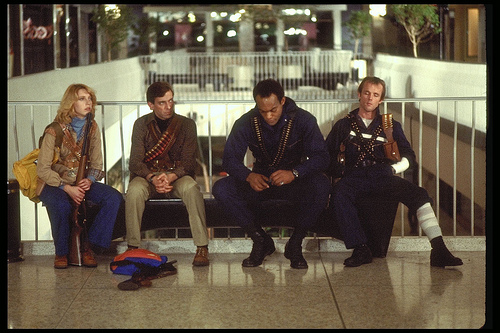
After Zardoz, Westworld, Logan’s Run, Woody Allen’s sublime Sleeper, these clean and almost workless worlds Keynes imagined the great-grandchildren he never had inhabiting, we get primarily, in film at least, dystopia, corporate dystopias in effect, and we also get a great deal of the post-apocalyptic. Awful visions of course, but also thrilling, they admit at least of adventure and heroism, by which we mean violence, by which we mean conquest. Thank god we have escaped a future of drifting through geodesic domes in glittery cubist togas, have revived the frontier spirit and can at last achieve a true Utopian Liberty.
Saturday, 18 July 2015
Shaviro-The Universe of things
It should be evident that beauty is appropriate to a world of relations in which entities continually affect and touch and interpenetrate one another, and that sublimity is appropriate to a world of substances, in which entities call to one another over immense distances and can only interact vicariously.
Subscribe to:
Posts (Atom)